3D Construction Printing: From Niche to Standardised Practice
As 3D construction printing (3DCP), or additive construction (AC), moves from eye‑catching demonstrations into real housing and infrastructure projects, one thing matters more than the headlines: standards, certification and warranty. Without a clear framework for how projects are qualified, audited and insured, 3DCP risks remaining an interesting niche rather than a dependable construction methodology.
Why standards matter for 3DCP
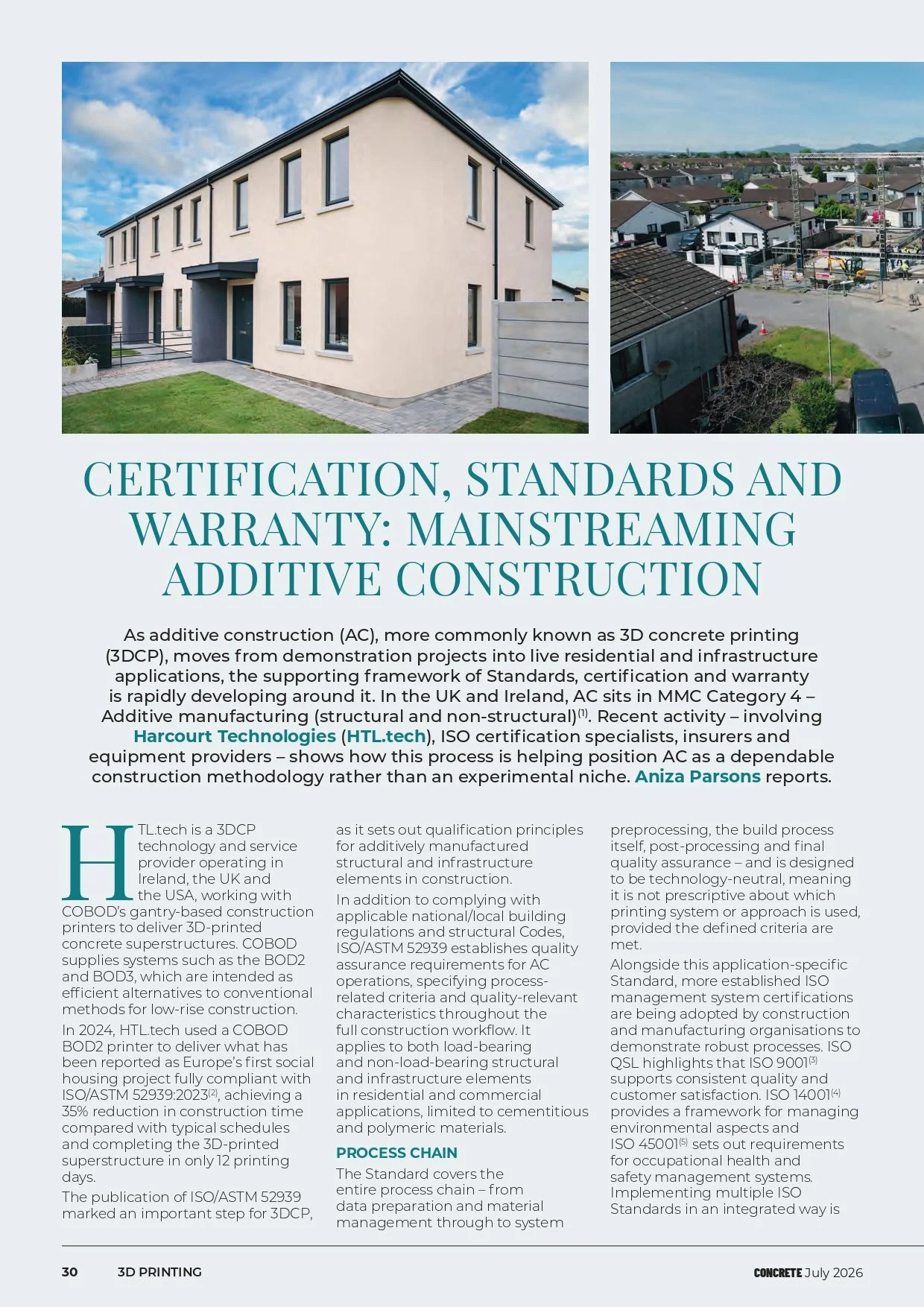
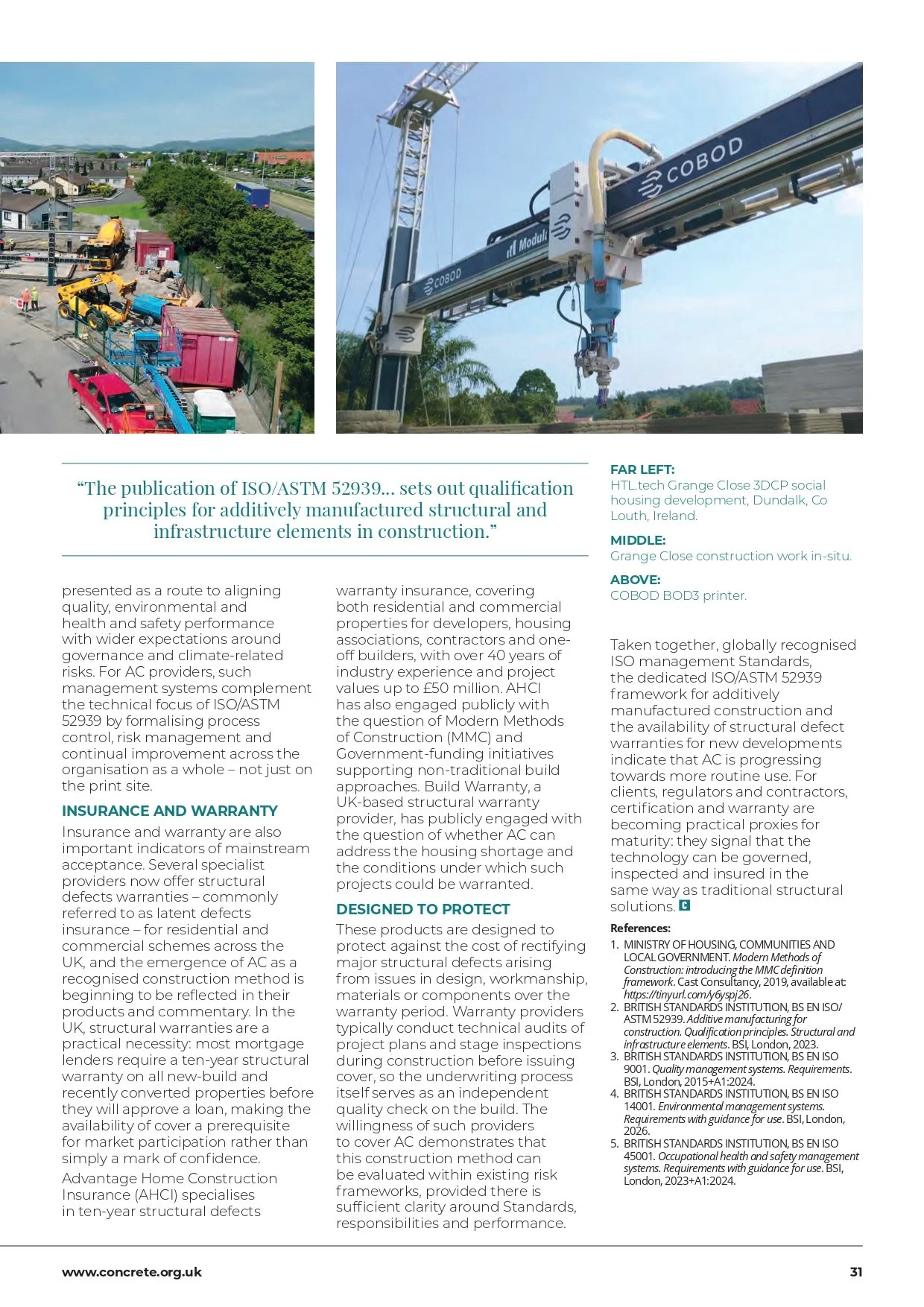
In the UK and Ireland, AC now sits in MMC Category 4 – additive manufacturing for structural and non‑structural applications. That categorisation reflects a growing acceptance that 3D‑printed concrete is not just experimental, but a genuine option for low‑rise construction and beyond. To support this shift, the standards landscape has started to catch up.
A key milestone was the publication of ISO/ASTM 52939, which sets out qualification principles for additively manufactured structural and infrastructure elements in construction. Rather than prescribing any one printer or mix design, it focuses on technology‑neutral criteria across the full process chain – from data preparation and material management through to the build itself, post‑processing and final quality assurance. This allows different 3DCP systems to be assessed against consistent benchmarks while leaving room for innovation.
Beyond the print: integrated management systems
Technical standards alone are not enough. They need to sit within broader organisational frameworks that cover quality, environment and health and safety. That’s why many AC and construction providers are adopting established ISO management system certifications – ISO 9001 for quality, ISO 14001 for environmental management and ISO 45001 for occupational health and safety.
Implemented in an integrated way, these certifications help providers demonstrate that control, risk management and continual improvement extend beyond the print site to the entire organisation. For clients and regulators, this alignment with globally recognised standards makes it easier to compare AC providers with traditional contractors using familiar criteria.
Warranty and insurance: practical proof of maturity
Perhaps the most tangible sign that 3DCP is entering the mainstream is the increasing availability of structural defect warranties for additive construction projects. In markets like the UK, a ten‑year structural warranty is effectively a requirement for mortgage lenders, making insurance a prerequisite for participation rather than a nice‑to‑have.
Specialist warranty providers now conduct technical audits and stage inspections on AC schemes, treating them within existing risk frameworks as long as standards, responsibilities and performance are clearly defined. Their willingness to underwrite these projects suggests that 3D‑printed structures can be evaluated and insured in much the same way as conventional builds, provided the right certification and quality assurance are in place.
From experimental to everyday
Taken together, ISO/ASTM 52939, integrated ISO management systems, and the emergence of robust warranty products show how 3D construction printing is being anchored in the same culture of governance and assurance that underpins traditional construction. As the industry continues to develop this framework, standardisation will be the bridge that allows AC to move confidently from innovation and pilot projects into everyday practice.